Big Picture Thinking: How to Teach Situational Awareness to Toddlers and Pre-schoolers
Introduction: Why Start Early?
Your toddler may still be learning to form full sentences, but their brain is already forming deep patterns about how to interact with the world. Situational awareness (the ability to perceive and process what’s going on around them) is not just for older kids. It starts with the small habits we build early.
You can lay the foundation of cognitive awareness in their development that will manifest in practical and useful ways years later.
“Awareness begins where attention is directed.
Start small and stay consistent.”
1. Early Awareness Training - Using What You Already Do
Story Time with Purpose
Reading to your child offers more than literacy—it creates the ideal space to train attention.
When your toddler wants you to read a book for the hundredth time, it’s hard for a parent to feign enthusiasm. Your child knows the story so well that if you attempt to shortcut the story in any way, they immediately recognize the ploy and squash it. When they know what’s coming next and reaches down to help you turn the page, here it’s a great opportunity to enhance their attention and add awareness training.
Besides concentrating on the main characters and foreground pictures, linger on the page and point to other characters and objects in the background. Ask them about colors or shapes. Try this:
While reading a picture book, ask:
“See the sun and clouds? Can you point to them?”
“Do you see that little bird sitting in the tree?”
“What else do you see?”
“What’s happening behind the main character?”
Do you see something hidden in the background?”
Look at the main character’s facial features. “What is the panda feeling?”
Use Spot the Difference, Hidden Pictures, Look & Find, and Where’s Waldo books to grow observational detail.

Reading is calming, builds literacy, nuance voicing, bonding, and awareness.
As they get older, picture books with rich and elaborate illustrations offer an opportunity to study a page, the colors, the designs and investigate what lies in all the corners.
Soon children will become curious and independently search the background on their own. They will learn to take in the whole picture instead of focusing on a singular main figure or the biggest object on the page.
You are helping them acquire an important skill set, noticing detail. This cognitive skill will serve them well in their future academic and professional life.
Art as a Medium for Choice, Attention, and Awareness
When toddlers use different textures (yarn, feathers, leaves, sponges), they engage their senses and begin learning how choices affect outcomes.
Let them pick the colors, textures, and shapes.
Use finger painting or recycled crafts and talk about their decisions: "Why did you choose blue there?"
Praise them for their uniqueness, their hard work, their patience, and their process.
Ask them to name their art work or give you the story behind it.
Creating art is also a wonderful way to experience mindfulness (being in the moment). It develops sensory awareness. Finger painting, learning to mix colors, adding strings or leaves, nothing is off limits. Don’t offer examples. Let them decide on the details and nuance of their art. Art is personal and an expression on how your child feels. Art is an effective tool that helps children become more aware, acquire confidence in their choices, and gain experience in making decisions.
Nature Walks and Backyard Explorations
Make it sensory rich.
Nature is another wonderful way to develop awareness because it touches all five of the senses. Use the “Stop, Look, and Listen” approach when out in nature.
Ask them to notice:
The wind:
”Do you see the plants and flowers moving back and forth?”
”Do you hear the noise of rustling leaves in the trees?”
”Can you feel the wind on your face?”
”The wind is whipping around our hair and clothes!”
”Look at that bag flying into the air or the leaves swirling in a circle.”
”Do you see how fast the clouds are moving?”The sky:
Notice the moon and the stars in the night sky.
Lay on the ground to find “pictures” or shapes in the clouds.
”Did you see that bird flying by or that airplane way up in the sky?”
”Do you feel the sun’s warmth on your face?”
”Is it cloudy, raining, or sunny right now?”Plants and animals:
Examine a flower, twig or leaf in detail.
Go barefoot and scour the grass for a four leaf clover.
”What different color flowers do you see? Did you see that bee gathering pollen?”
”Can you hear the birds chirping, the leaves rustling, or the water in the running stream?”
”Can you smell the woods or the river?”
”Let’s look under this rock. What do you see?”
”See the ants. Let’s watch where they go?”

Sensory Play
Spending time in nature benefits the body and brain in many ways. By adding this awareness training you strengthen your child’s cognitive skills and their ability to process and grasp information.
One day, my son and I were sitting on a hill eating a picnic lunch. We were admiring the sky and the valley below, when he said, “Mommy, this looks like a gigantic painting.” I was pleased that he could take it in all at once, seeing the big picture.
This cognitive awareness training can easily be transferred to our goal of safety awareness. As children learn to see the big picture, recognize ploys that undermine safety or potentially dangerous situations, and learn to discern the motivation of others, they “see” their environment in totality and can act accordingly to keep themselves safe.
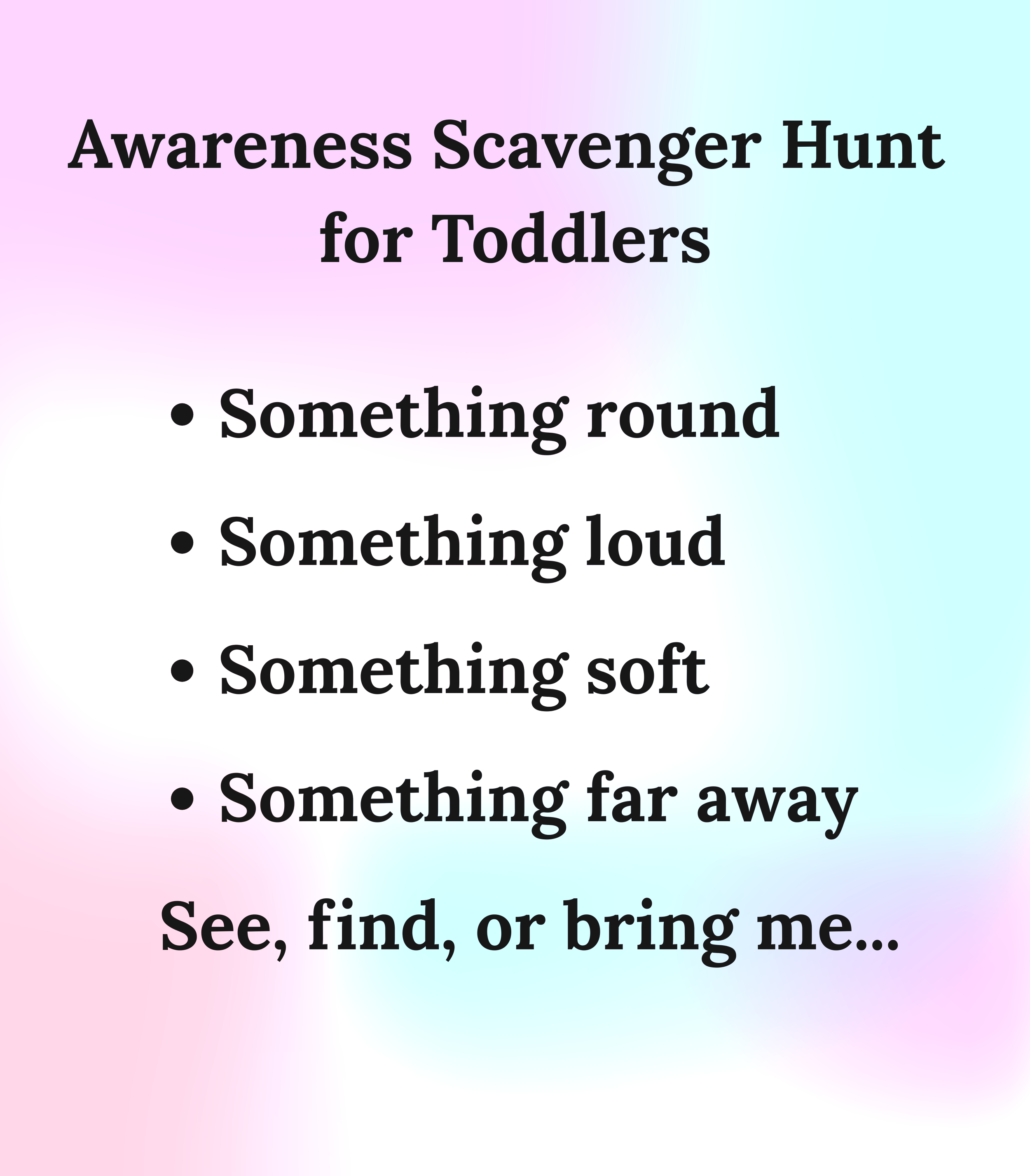
2. Simple Routines That Build Big Picture Thinking
In The Car - Road Trip Games:
While you travel with your child, play games that train observational skills.
Play “I Spy” using textures, colors, and movement. “I spy with my little eye, something with the color blue.”
Alphabet Game - There are variations to this game depending on your child’s learning level.
- Find letters A-Z on signs, billboards or license plates. “I spot the letter A on that billboard. I see a the letter T on the stop sign. I found the letter Z on that plate.” Give your child a worksheet to keep track of the letters found, until it’s all filled up.
- Another variant is to find something or someone that can represent letters, such as “I see a man with an Arm for the letter A.” Then move on to the letter B. “I found a someone wearing a Blue skirt. There is a Car. I see a Dog. Mailman carrying Envelops,”and so forth. Move down the alphabet without skipping letters.Scavenger Hunt - Bring a worksheet with a list of things you commonly see on the road. Your child can mark each item off the list. The first one to do so wins.
License Plates Game - This game is an ongoing game on our road trips that lasts for months. Touring around town or long road trips, have a worksheet with a map of the country. Kids can color in the state when they find its license plate.
To build self-esteem, praise your children for being so observant, finding letters so fast, or for seeing things that you didn’t see.
Toy Play and Role-Play
Encourage building environments (Legos, blocks, play kitchens) and discuss the “world” they built. When they draw a picture, ask for a story about their drawing.
Cosplay or role-play animals or objects, “What noises does a cat make? How would a bunny move from place to place? Let’s be a snake or an alligator? What would a monkey do?”
“Let’s pretend we are driving a car? How about we sound like a fire engine or a choo choo train?”
Conclusion: You’re Already Halfway There
Parents don’t need to add more to their plate. By adjusting your lens during everyday activities, you help your child build the foundation for lifelong safety and self-awareness.
Quick Tip Recap:
Use story time to scan the whole page.
Let kids lead in art and explain their choices.
Use nature to engage all five senses.
Play observations games often.
###
You might also like these blog posts under the category:
Teaching Children Situational Awareness:
School Aged Children: Raising a Safety-Conscious Child: Situational Awareness for ages 5-8.
Teen Girls: Strong, Smart, and Safe: Teaching Teen Girls the Power of Situational Awareness
Order or get more information about my comprehensive ebook and worksheets.
Scroll to half page and get more info here:
The Big Picture: A Parent’s Guide to Teaching Situational
Awareness to Children of All Ages